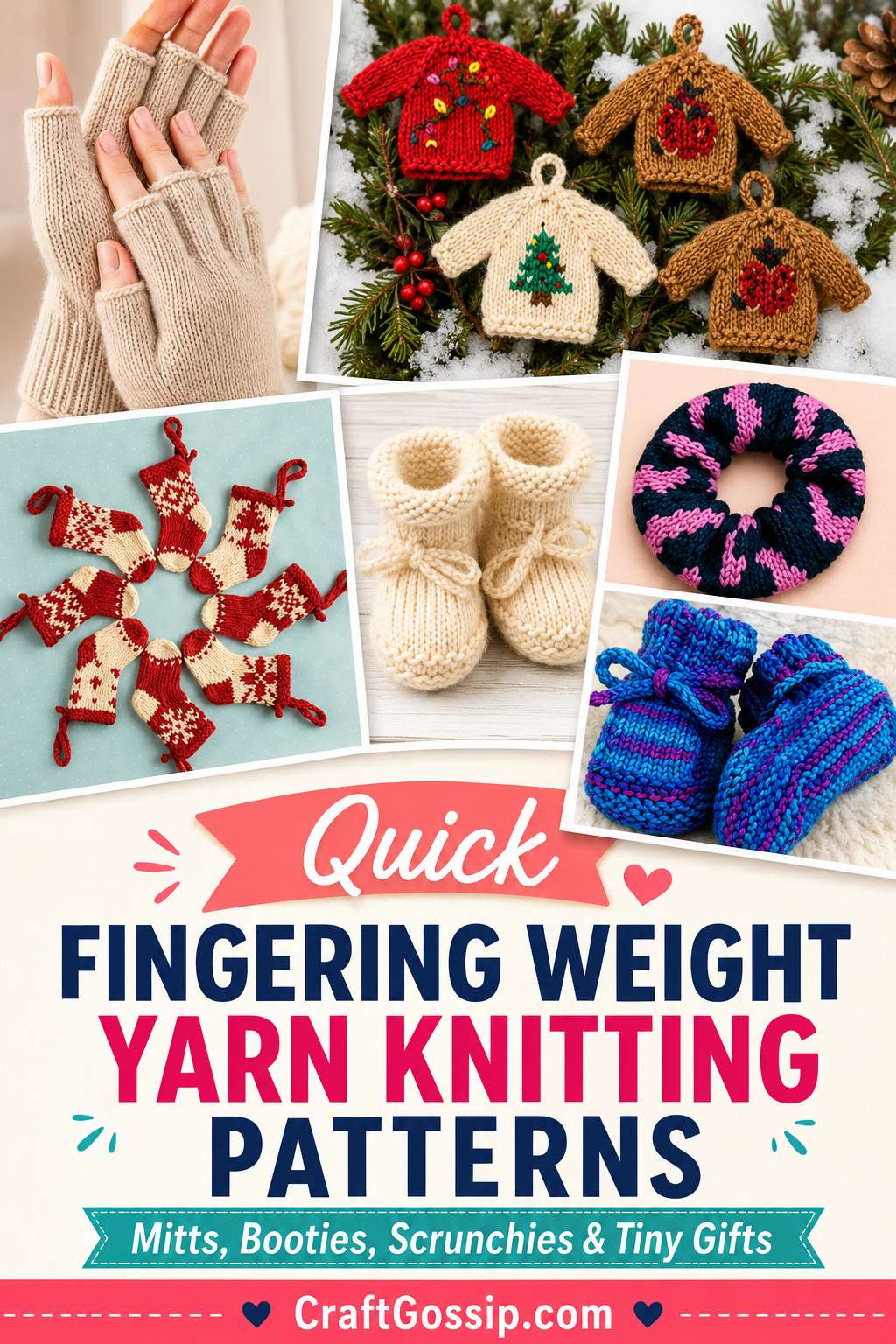
Fingering-weight yarn is beautiful, economical and wonderfully versatile, but I’ll be the first to admit that it doesn’t immediately spring to mind when someone says “quick knitting project.” Fine yarn and tiny needles can make us picture complicated lace shawls, second socks and projects quietly ageing in the bottom of the knitting basket.
Thankfully, fingering-weight yarn does not have to mean weeks of knitting.
Small accessories, baby booties, scrunchies, miniature decorations and simple fingerless mitts can all be satisfying little projects for those odd balls of sock yarn we cannot bear to throw away. You know the ones: far too lovely for the scrap bin, but not quite enough to make another full pair of socks.
These quick fingering weight yarn knitting patterns are especially handy when you need a small handmade gift, a portable project for appointments or something manageable to knit between larger projects. Many use less than one skein, while several need only a few precious metres of leftover yarn.
Quick Fingering Weight Knitting Patterns From CraftGossip
Sock Yarn Mittens And Mitts Knitting Patterns
This CraftGossip collection is a very useful starting point when your leftover sock yarn is begging to become something other than socks. It includes fingerless gloves and mittens designed for fingering or sock-weight yarn, with several simple one-colour options that are far less intimidating than elaborate stranded designs.
Helical Knitting Patterns
Helical knitting creates seamless stripes without that awkward little jog where the colours meet. The collection includes the Helical Twins fingerless mitts, which use fingering-weight yarn and straightforward garter stitch—a lovely project for two small coordinating leftovers.
Knit A Pretty Floral Project Bag
This sweet drawstring project bag is made with two colours of fingering-weight yarn and has a small band of floral colourwork near the base. It is a little larger than the other quick projects here, but still manageable—and you end up with a useful bag for corralling your next small knitting project.
Quick Fingerless Mitts And Gloves In Fingering Yarn
Fingering Weight Fingerless Mittens
Kate Atherley’s simple fingerless mitts were deliberately designed with a shorter cuff and hand, helping them knit more quickly and use smaller quantities of yarn. One mitt takes approximately 15 to 20 grams of fingering-weight yarn, making this a clever pattern for leftovers from a much-loved pair of socks.
The uncomplicated thumb opening also makes these approachable for knitters who are comfortable working in the round but have not yet ventured into full mitten construction.
Very Classic Fingerless Gloves
Purl Soho provides both full-glove and fingerless versions of this elegant pattern. Naturally, the fingerless option is the quicker choice, and its clean stockinette fabric makes a beautiful showcase for cashmere, alpaca, merino or any especially soft fingering-weight yarn.
These would make a particularly thoughtful gift because they look polished without relying on fussy stitch patterns.
Fast Fingering Weight Scrunchie Patterns
Soho Scrunchie
The Soho Scrunchie is specifically described as a quick project for leftover yarn and includes instructions for several yarn weights. The fingering-weight version starts at approximately 42 yards for the smallest size, so even a modest leftover ball may be enough.
It is worked seamlessly around a hair elastic, producing a proper fabric-covered scrunchie rather than a narrow knitted strip tied around elastic.
Glossier Scrunchie
This free knitted scrunchie pattern can be worked with fingering or DK-weight yarn and includes a touch of colourwork. It is a fun way to combine two tiny leftovers that might otherwise be too small for anything useful.
Gauge is not especially critical, which is always welcome when you simply want a relaxing little evening knit rather than a full swatching ceremony.
Scrunchie Knitting Pattern For Any Yarn
This beginner-friendly pattern includes small, regular and oversized scrunchie options and can be adapted for different yarn weights. Choose the smaller size and fingering-weight yarn for an easy stash-busting accessory that is practical, giftable and wonderfully forgiving.
A handful of coordinating scrunchies would also make a charming addition to a handmade market stall or a teenager’s Christmas stocking.
Quick Baby Knits Using Fingering Weight Yarn
Baby Boots
These tiny baby boots by Frankie Brown are worked in sock-weight 4-ply yarn and measure approximately 8 centimetres through the foot. They are knitted in one piece and joined at the back of the cuff and along the sole.
Small baby knits are one of the best ways to make fine yarn feel quick. You still get the dainty stitches and beautiful drape of fingering-weight yarn, but without casting on enough stitches for an adult-sized garment.
Christine’s Stay-On Baby Booties
This free fingering-weight pattern has a lovely bit of knitting history behind it. The design is credited to Christine Bourquin, who shared it in a letter to Threads magazine when she was 95 years old.
The clever ribbed sides help the booties stay on tiny feet—always the real test of a baby bootie pattern. They use approximately 70 to 120 yards, depending on yarn, gauge and size.
Sock Yarn Baby Booties
These baby booties use approximately 70 yards of fingering-weight sock yarn and are worked sideways. Seed stitch gives them a lovely texture, while the small scale keeps the project achievable when you need a baby gift without committing to a cardigan or blanket.
This is also a sensible use for durable superwash sock yarn, particularly when the finished booties are destined for real life rather than merely looking pretty in a gift box.
Toasty Toes Baby Booties
The Toasty Toes booties are designed as a quick, simple knit using small amounts of leftover sock yarn. They are worked flat from the bottom centre and finished with a single seam, making them friendly for knitters who would rather avoid juggling tiny double-pointed needles.
As written, the pattern fits a newborn, but the designer also explains that the size can be adjusted through gauge or stitch-count changes.
Tiny Fingering Weight Knitting Patterns And Decorations
Mini Christmas Stocking Ornaments
These tiny stockings measure approximately two to three inches and need only around five to seven yards of fingering-weight yarn. That makes them ideal for the very smallest scraps—the colourful little lengths we keep because throwing them away feels practically criminal.
The stockings are knitted flat, which is helpful for anyone who does not enjoy working tiny circumferences in the round. Use them as tree decorations, gift tags, advent-calendar pockets or place-setting decorations.
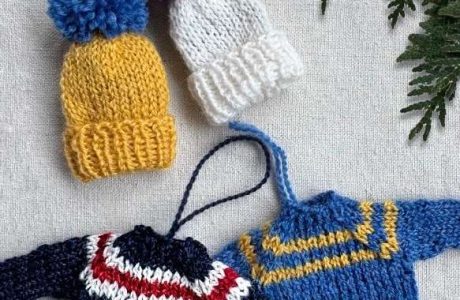
Tiny Sweaters
Each of these miniature sweaters uses around 24 yards of sock or fingering-weight yarn. They can become Christmas ornaments, parcel toppers, egg cosies or tiny gifts for knitting friends.
They are also a surprisingly useful way to practise top-down raglan construction on a miniature scale before tackling a full-sized sweater. It is the knitting equivalent of a dress rehearsal—only much cuter.
What Can You Knit Quickly With Fingering Weight Yarn?
The quickest fingering-weight knitting patterns are usually projects with a small finished surface area. Scrunchies, baby booties, miniature ornaments, short fingerless mitts and tiny decorative garments can all be completed without the enormous stitch counts associated with socks, shawls and adult clothing.
For the fastest results, look for patterns with:
- Simple stockinette, garter or ribbed fabric
- Minimal shaping
- Short cuffs and compact dimensions
- Flat construction with one small seam
- Fewer than 100 yards of yarn
- Gauge that does not need to be exact
Using fingering yarn held double is another way to speed things up, although it creates a fabric closer to sport or DK weight and may require a different pattern or gauge calculation.
Before You Toss Those Sock Yarn Scraps
It is amazing how useful a small amount of fingering-weight yarn can be once you stop insisting that every ball must eventually become a sock. Even the tiniest leftovers can turn into a scrunchie stripe, a miniature stocking, a baby bootie or a cheerful little sweater ornament.
Keep similar fibres together, label leftovers when you can and store the smallest amounts where you can actually see them. Otherwise, they have an unfortunate habit of disappearing into a bag marked “sock yarn scraps” until approximately 2043.
These quick fingering weight yarn knitting patterns are proof that fine yarn can still deliver that satisfying little burst of finishing something. And honestly, sometimes casting off a tiny sweater before bedtime is exactly the crafty victory we need.