• Home
  • Suggest A DIY
  • DIY Newsletter

Knitting

Free Patterns, Tutorials and Project Ideas

  • About CraftGossip
  • Our Network
    • Bath & Body Crafts
    • Candle Making Ideas
    • Crochet Ideas
    • Cross Stitch
    • Edible Crafts
    • Felting Patterns
    • Glass Art
    • Home & Garden Ideas
    • Indie Crafts
    • Jewelry Making
    • Kids Crafts
    • Knitting Patterns
    • Lesson Plans
    • Needlework
    • Party Ideas
    • Polymer Clay
    • Quilting Ideas
    • Recycled Crafts
    • Scrapbooking
    • Sewing Patterns
    • Card Making
    • DIY Weddings
    • Not Craft Ideas
  • Giveaways
  • Roundups
  • Store
  • Search

Bluey Knitting Patterns

June 9, 2024 by Sarah White

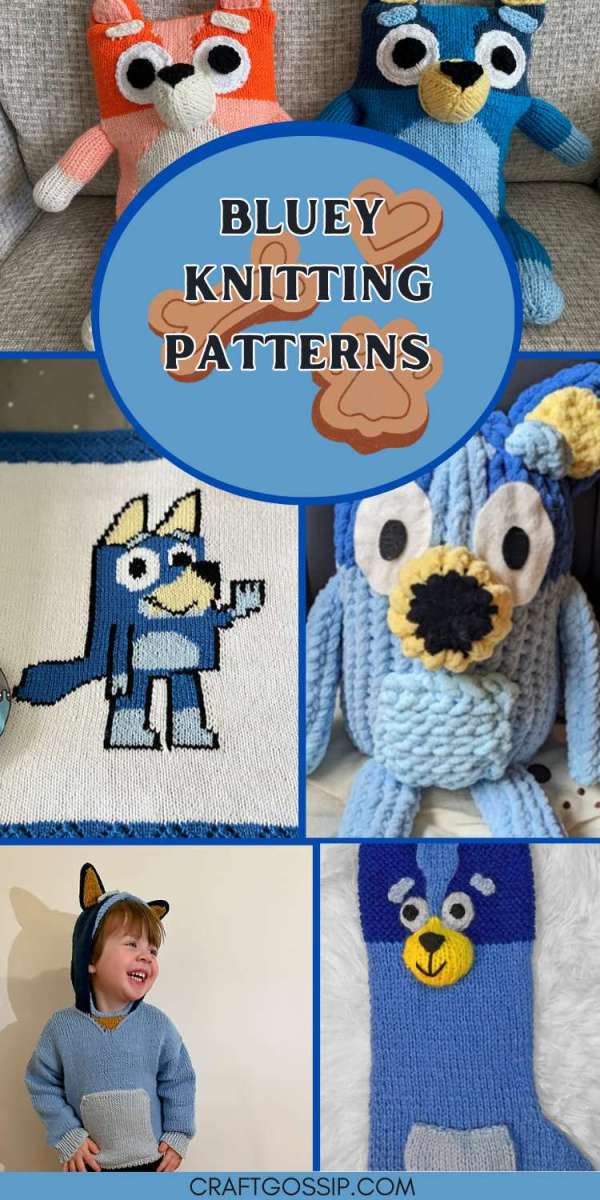
It seems the favorite kids show for both children and adults these days is Bluey, and while there are a lot more Bluey themed crochet projects than there are knitting ones, I was able to find a few Bluey knitting patterns if you want to make them for a kiddo (or an adult!) in your life.

We’ll start with the characters, of which I could only find Bluey and Bingo knit doll patterns, but you could probably change the size and colors to make them different characters.

This version from Knits n Giggles by Stacey uses rectangles for the body so it’s a good choice for newer knitters. It does have colorwork on the body to make their spots and stripes.

Yarn Haven by Page has another version that’s all worked flat on two needles and seamed together. This one uses DK weight yarn and has the color changes for both Bluey and Bingo.

If you like loom knitting you can try this Bluey loom knitting pattern from Illoominated Design Co. It uses blanket yarn and can be worked all on a 31 peg loom or you can use smaller looms to make the limbs and other features if you have them.

If you’d rather knit something with Bluey on it, there are a few options there, too. Dr. Ella Horn has a Bluey sweater sized for kids aged 4-10, which uses DK weight yarn and has super cute stripes on the sleeves. You can find this one on Ravelry. Or try the Bluey Toddler Jumper from Not Just Nana’s Knit on Ravelry. This one uses DK yarn and is sized for 12-24 months and 24-36 months.

Not Just Nana’s Knit also has a baby blanket pattern on Ravelry featuring Bluey. 

Arianna Soloway has a cute hoodie pattern sizes for ages 6 months to 8 years that can be made in colors to suit Bluey or Bingo. I love the little ears and kangaroo pouch! This one is worked in worsted weight yarn and is available on Ravelry.

And if you’re thinking about Christmas you can stitch up this adorable Bluey inspired Christmas stocking, from Rebecca Roberts on Ravelry.
Next Pattern:

  • Circular Knitting Machine Hat Knitting Patterns
  • Book Review - 52 Weeks of Socks: Beautiful patterns…
  • Book Review - Selbu Patterns: Norwegian Knitting
«
»

Have you read?

15 Bind-Off Methods Every Knitter Should Know And When To Use Them

Binding off is one of those knitting skills that sounds very simple until you realise the edge of your project has a personality of its own.

Too tight? Your sock will not go over your heel.

Too loose? Your sweater neckline slowly turns into something that looks like it has given up on life.

Too bulky? Suddenly that neat little shoulder seam has a ridge you could trip over.

If you have ever finished a beautiful piece of knitting only to be disappointed by the cast-off edge, you are absolutely not alone. Most knitters learn the basic bind off first, use it on everything for years, and then slowly discover that there is a whole world of bind-off methods hiding behind the phrase “bind off loosely.”

This guide is designed to help you choose the best knitting bind-off method for your project, without needing to memorise every technique under the sun. Think of it as your handy little cast-off cheat sheet.

And if your final stitch always seems to look a little wobbly, do not worry — we have already covered how to handle a messy last stitch when you bind off, because honestly, that final stitch can be a tiny menace.

Bind Off Or Cast Off: What Is The Difference?

Bind off and cast off mean the same thing.

In the United States, patterns usually say bind off. In the UK, Australia, and many older knitting patterns, you are more likely to see cast off. Either way, it means you are finishing the live stitches so they do not unravel.

The trick is choosing a bind-off method that suits the fabric you have just made.

How To Choose The Best Bind-Off Method

Before you choose a bind off, ask yourself three quick questions:

  1. Does the edge need to stretch?
    Socks, cuffs, hat brims, necklines, and ribbing usually need a stretchy bind off.
  2. Does the edge need structure?
    Shoulder seams, bags, blankets, and garments that carry weight may need a firmer bind off.
  3. Is the edge decorative?
    Shawls, washcloths, baby blankets, and cuffs can look lovely with a picot, I-cord, or lace-style bind off.

A good bind off should match the job of the finished edge. That sounds obvious, but it is exactly where many knitting projects go a bit sideways.

Quick Bind-Off Comparison Chart

Bind-Off MethodBest ForStretch LevelSkill Level
Basic bind offDishcloths, scarves, firm edgesLowBeginner
Bind off in patternRibbing, seed stitch, textured stitchesMediumBeginner
Suspended bind offShawls, blankets, relaxed edgesMediumBeginner-friendly
Stretchy bind offHats, cuffs, casual ribbingHighEasy
Jenny’s Surprisingly Stretchy Bind OffSocks, toe-up socks, cuffsVery highEasy/intermediate
Russian bind offSocks, cowls, stretchy edgesHighEasy
Icelandic bind offGarter stitch, shawls, blanketsMedium/highIntermediate
Sewn bind offSocks, cuffs, delicate edgesHighIntermediate
Tubular bind off1×1 ribbing, sweater neckbandsHighIntermediate
I-cord bind offShawls, blankets, cardigansLow/mediumIntermediate
Eyelet I-cord bind offDecorative shawls, skirts, cowlsMediumIntermediate
Picot bind offBaby knits, dishcloths, feminine edgesLow/mediumIntermediate
Three-needle bind offShoulder seams, joining piecesLowIntermediate
Kitchener bind offSock toes, invisible joinsMediumIntermediate
Crochet bind offQuick edges, mixed craft projectsLow/mediumBeginner-friendly

1. Basic Bind Off

The basic bind off is the one most knitters learn first. You knit two stitches, lift the first stitch over the second, knit another stitch, and repeat across the row.

It creates a neat, firm edge and works beautifully for simple scarves, dishcloths, blanket squares, and projects where the edge does not need to stretch much.

The downside? It can be too tight, especially for socks, cuffs, and necklines.

Best for: scarves, dishcloths, straight edges, beginner projects
Avoid for: toe-up socks, tight cuffs, very stretchy ribbing

Shellie’s tip: If your basic bind off is always too tight, try using a needle one or two sizes larger in your right hand as you bind off. It is one of those simple tricks that saves a lot of grumbling.

2. Bind Off In Pattern

Binding off in pattern means you keep working the stitches as they appear while binding off. If the stitch is a knit stitch, knit it. If it is a purl stitch, purl it.

This is especially useful for ribbing, seed stitch, moss stitch, and textured knitting patterns because it keeps the finished edge looking like part of the fabric instead of a random line across the top.

If you are working something like ribbing or fisherman’s rib, this matters even more. Our tutorial on how to knit fisherman’s rib is a helpful place to start because stretchy ribbed fabrics really do need a cast on and bind off that allow the stitch pattern to behave properly.

Best for: ribbing, seed stitch, moss stitch, textured scarves, cowls
Avoid for: projects needing extreme stretch

3. Suspended Bind Off

The suspended bind off is a slightly stretchier version of the basic bind off. It gives the stitches a little extra room before they are lifted over.

This is a good next step if you are a beginner and the basic bind off feels too tight, but you are not ready for sewn or tubular methods.

Best for: shawls, blankets, washcloths, relaxed garment edges
Avoid for: very firm seams or edges that need structure

4. Simple Stretchy Bind Off

A simple stretchy bind off usually adds a yarn over or extra movement between stitches to create more give. There are several versions, but the idea is the same: you are building more yarn into the edge so it can expand.

This is a great everyday bind off for hats, cuffs, cowls, and anything that needs to stretch over a body part without cutting off circulation. We are making lovely things here, not medieval finger traps.

Best for: hats, sleeves, cowls, baby garments, casual ribbing
Avoid for: sweater necklines that need to hold their shape firmly

5. Jenny’s Surprisingly Stretchy Bind Off

Jenny’s Surprisingly Stretchy Bind Off is a favourite among sock knitters because it adds yarn overs between stitches, creating a very flexible edge.

It is especially useful for toe-up socks, where the cuff needs to stretch over the heel. It can also work for sleeves, mitts, cowls, and any ribbed edge that needs serious give.

Best for: toe-up socks, cuffs, mittens, ribbed edges
Avoid for: edges that need to look very firm or structured

If sock knitting is your happy place, you may enjoy our review of No Fear Sock Knitting, especially if you want to feel less intimidated by sock construction.

6. Russian Bind Off

The Russian bind off, sometimes called an elastic bind off, is another stretchy method that is easier than it looks. Instead of simply passing one stitch over another, you knit stitches together through the back loop as you work across the row.

It creates a flexible edge without requiring a tapestry needle, which makes it a nice option if sewn bind-offs make you mutter under your breath.

Best for: socks, cowls, hats, stretchy sweater edges
Avoid for: delicate lace where you want a very fine finish

7. Icelandic Bind Off

The Icelandic bind off is a beautiful match for garter stitch. It creates a slightly decorative, flexible edge that looks tidy without being too tight.

This is a lovely choice for shawls, blankets, and garter stitch scarves. If your project has that squishy, comforting garter stitch texture, the Icelandic bind off often looks more natural than a basic bind off.

Best for: garter stitch shawls, blankets, scarves
Avoid for: very sleek stockinette edges

8. Elizabeth Zimmermann’s Sewn Bind Off

This sewn bind off uses a tapestry needle instead of knitting needles to finish the stitches. It creates a stretchy, soft edge and is often used for socks, cuffs, and ribbing.

The only catch is that you need to leave a long enough tail before you begin. I always recommend leaving more yarn than you think you need, because running out halfway through a sewn bind off is the kind of knitting drama nobody asked for.

Best for: socks, cuffs, necklines, flexible ribbing
Avoid for: projects where you have a very short yarn tail

A good blunt tapestry needle makes this much easier. If you are putting together a basic knitting notions pouch, a set of tapestry needles, locking stitch markers, and small scissors are the sort of inexpensive tools you will use constantly. Amazon usually has handy little knitting notions kits, and Mary Maxim is a good place to browse yarn and beginner-friendly knitting supplies.

9. Tubular Bind Off

The tubular bind off, also called Italian bind off, is one of the prettiest finishes for ribbing. It makes the ribbing look like it rolls seamlessly over the edge, which is why it is so popular for sweater neckbands, cuffs, and polished garments.

It takes more patience than a basic bind off, but the result is worth it on projects where the finish really shows.

Best for: 1×1 ribbing, sweater neckbands, cuffs, polished garments
Avoid for: quick projects where a simple edge is fine

10. I-Cord Bind Off

The I-cord bind off creates a rounded cord along the edge of your knitting. It gives a beautifully finished look and adds a bit of weight and structure.

It is often used on shawls, blankets, cardigans, and modern accessories. It is not the stretchiest option, but it is very neat.

If you like decorative edges, our post on the eyelet I-cord bind off is a fun technique to try when you want something a little more special.

Best for: shawls, blankets, cardigans, modern edges
Avoid for: sock cuffs or tight ribbing

11. Eyelet I-Cord Bind Off

The eyelet I-cord bind off adds little eyelets beneath the I-cord edge. It is decorative without being overly fussy, and it can look lovely on shawls, cowls, skirts, bags, and children’s garments.

It is one of those techniques that makes people ask, “How did you do that?” which is always satisfying.

Best for: decorative shawls, cowls, bags, skirts
Avoid for: plain utilitarian edges where eyelets would look odd

12. Picot Bind Off

The picot bind off creates tiny points along the edge of your knitting. It is sweet, decorative, and especially lovely for baby blankets, washcloths, doll clothes, cuffs, and feminine accessories.

We have a nice example of this in our stash-busting frilly circular washcloth knitting pattern, where the picot bind off gives the project that pretty ruffled finish.

Best for: baby knits, dishcloths, lace edges, gift projects
Avoid for: masculine accessories or projects needing a very plain edge

13. Three-Needle Bind Off

The three-needle bind off is used to join two pieces of knitting while binding off at the same time. It is firm, tidy, and excellent for shoulder seams.

It is a practical method for sweaters because it creates a strong seam without needing to sew pieces together later. And anything that reduces finishing is a win in my book.

We also have an older CraftGossip post with tips on the three-needle bind off if you want to explore this technique further.

Best for: shoulder seams, joining live stitches, bags, sturdy seams
Avoid for: invisible seams or soft stretchy edges

14. Kitchener Stitch Bind Off

Kitchener stitch is not a traditional bind off in the same way as the others. It is a grafting method that joins two sets of live stitches invisibly.

Sock knitters use it all the time for toes, but it can also be used for cowls, scarves, mittens, and any place where you want the join to disappear.

It can feel a bit like knitting witchcraft the first few times, but once you get the rhythm, it is not nearly as scary as it looks.

Best for: sock toes, invisible joins, grafted cowls
Avoid for: projects where a visible seam is acceptable and quicker

15. Crochet Bind Off

A crochet bind off uses a crochet hook instead of a knitting needle to pull stitches through and finish the edge.

This can be quick and handy, especially if you are comfortable with crochet. It is also useful for some circular knitting machine projects, quick accessories, and mixed-technique pieces.

If you are making simple handmade gifts, this is one of those practical skills that is worth having tucked away.

Best for: quick edges, mixed knitting and crochet projects, machine-knit pieces
Avoid for: highly polished garment edges

Best Bind-Off Methods By Project Type

Best Bind Off For Socks

For toe-up socks, choose a stretchy bind off such as Jenny’s Surprisingly Stretchy Bind Off, the Russian bind off, or a sewn bind off. Sock cuffs need enough stretch to go over the heel without sagging once worn.

Best Bind Off For Ribbing

For ribbing, bind off in pattern if you want a simple finish. For a more polished finish, use a tubular bind off. For extra stretch, use Jenny’s Surprisingly Stretchy Bind Off or a sewn bind off.

Best Bind Off For Sweater Necklines

A sweater neckline needs stretch, but not too much. A tubular bind off is beautiful for ribbed neckbands, while a sewn bind off can work well if you control the tension. Avoid anything so loose that the neckline grows while worn.

Best Bind Off For Shawls

Shawls often need a relaxed or decorative edge. Try a suspended bind off, Icelandic bind off, I-cord bind off, picot bind off, or eyelet I-cord bind off, depending on the look you want.

Best Bind Off For Blankets

For blankets, choose a bind off that suits the stitch pattern. Basic bind off works for simple squares. I-cord bind off gives a polished edge. Picot bind off is lovely for baby blankets. Icelandic bind off works nicely with garter stitch.

Best Bind Off For Dishcloths

Dishcloths are brilliant for practicing new bind-offs because they are small and useful. Try a basic bind off, picot bind off, suspended bind off, or I-cord bind off.

Cotton yarn is ideal for dishcloth practice because it shows stitches clearly and gives you a useful finished project. If you are making a stack for gifts, look for cotton yarn packs from Mary Maxim or affordable cotton yarn bundles on Amazon.

Common Bind-Off Problems And How To Fix Them

My Bind Off Is Too Tight

Try using a larger needle in your right hand, relaxing your tension, or switching to a stretchier bind off. This is especially important for socks, cuffs, hats, and necklines.

My Bind Off Is Too Loose

Use a smaller needle, switch to a firmer bind off, or work the edge in pattern. Loose necklines and cuffs can stretch out over time, so do not automatically choose the stretchiest option for every project.

My Last Stitch Looks Messy

That last stitch often stretches out because it has extra room to move. Try tightening the final stitch gently before securing the tail, or use a technique specifically designed to neaten the last stitch. Our post on fixing a messy last bind-off stitch is worth bookmarking.

My Edge Flares Out

A flared edge usually means the bind off has too much stretch for the fabric. Try a firmer bind off, use fewer added yarn overs, or go down a needle size.

My Edge Pulls In

An edge that pulls in means the bind off does not have enough yarn in it. Use a larger needle or a stretchier bind-off method.

Should You Always Bind Off Loosely?

No, and this is where knitting advice can be a little too vague.

“Bind off loosely” is helpful when you are making socks, cuffs, shawls, or anything that needs stretch. But a loose bind off is not always best. A shoulder seam needs strength. A neckline needs recovery. A bag handle needs firmness.

Instead of always binding off loosely, aim to bind off appropriately for the project.

Beginner-Friendly Bind-Off Practice Project

If you want to practice several bind-off methods without committing to a large project, knit a set of small dishcloths or swatches.

Try this:

  • Knit one dishcloth with a basic bind off.
  • Knit one with a suspended bind off.
  • Knit one with a picot bind off.
  • Knit one with an I-cord bind off.
  • Knit one in ribbing and bind off in pattern.

Label them if you are feeling organised. Or toss them in the kitchen drawer and pretend it was a very practical experiment. Both count.

Helpful Knitting Supplies For Better Bind-Offs

You do not need fancy tools to bind off well, but a few basics make life easier:

  • Blunt tapestry needles for sewn bind-offs and weaving in ends
  • Interchangeable needles or spare larger needles for looser bind-offs
  • Smooth cotton yarn for practicing
  • Stitch markers for counting bind-off sections
  • A small crochet hook for crochet bind-offs or rescuing dropped stitches
  • A good knitting reference book if you like having techniques in print

If you are building your knitting library, a bind-off and cast-on reference book is genuinely useful because different projects really do need different finishes. It is the sort of book I reach for when a pattern simply says “bind off loosely” and leaves me to make the adult decisions.

Knitting Bind-Off FAQ

What is the easiest bind off for beginners?

The easiest bind off is the basic knit bind off. It is simple, tidy, and works well for many beginner projects like scarves, dishcloths, and blanket squares.

What is the stretchiest bind off?

Jenny’s Surprisingly Stretchy Bind Off is one of the stretchiest common bind-off methods. It is especially popular for toe-up socks and ribbed cuffs.

What bind off should I use for ribbing?

For a simple finish, bind off in pattern. For a polished professional finish, use a tubular bind off. For extra stretch, use a sewn bind off or Jenny’s Surprisingly Stretchy Bind Off.

What bind off should I use for garter stitch?

The Icelandic bind off is a lovely choice for garter stitch because it blends well with the texture and gives the edge a little flexibility.

Can I use a crochet hook to bind off knitting?

Yes. A crochet bind off uses a crochet hook to pull stitches through and finish the edge. It is quick and useful, especially if you are comfortable with crochet.

Why does my bind off look uneven?

Uneven bind-offs usually come from inconsistent tension. Try slowing down, keeping each stitch the same size, and using a larger needle if your edge is tight.

How much yarn do I need to bind off?

For most basic bind-offs, you need roughly the same amount of yarn as one knitted row, plus extra for weaving in. Sewn bind-offs need more, so leave a generous tail.

A Better Finish Starts With The Right Bind Off

The bind off might be the last thing you do, but it has a huge effect on how your finished knitting looks and wears.

A basic bind off is perfectly fine for many projects, but once you start matching your bind off to your knitting, your finished pieces will look neater, fit better, and last longer. Socks will stretch. Necklines will behave. Shawls will drape. And that final edge will stop looking like an afterthought.

Honestly, it is one of those small knitting upgrades that makes you wonder why nobody told you sooner.


Categories

baby hat Baby Patterns Beginner Book Reviews cardigan Christmas CraftGossip Giveaways Craft News and Events Free Knitting Patterns Giveaways! Hats Knitting Articles Of Interest Knitting Patterns Knitting Technique & Ideas mittens Quick scarf shawl patterns socks Sweaters

RSS More Articles

  • 12 Summer Sea Scene Card Ideas
  • Lincraft To Close Its Remaining Storefronts Across Australia And New Zealand
  • Pretty Tank Top Knitting Patterns to Keep You Cool
  • Seagull Cross Stitch Patterns
  • Mini Mending Mondays: Mend a Frayed Pocket Edge with Decorative Running Stitch
  • String Quilt Ideas for Skinny Strips and Rotary-Cutting Leftovers Scraps
  • 25 Clever Things To Make With Sweaters That Shrunk In The Wash
  • Bread Machine Nutella Cinnamon Rolls – Easy Gooey Recipe
  • Sea Salt Sweet – A Cookbook for Those of Us With a Salt Tooth
  • 10 DIY Wood Arbors You Can Build for a Beautiful Garden Entry

Pick Your Blog

  • Sewing
  • Knitting
  • Quilting
  • Crochet
  • Home & Garden
  • Recycled Crafts
  • Scrapbooking
  • Card Making
  • Polymer Clay
  • Cross-Stitch
  • Edible Crafts
  • Felting
  • Glass Art
  • Indie Crafts
  • Kids Crafts
  • Jewelry Making
  • Lesson Plans
  • Needlework
  • Bath & Body
  • Party Ideas
  • Candle Making
  • DIY Weddings
  • Not Craft
  • Free Craft Projects

Copyright © 2026 · CraftGossip | Start Here | Contact Us | Link to Us | Your Editors | Privacy and affiliate policy