• Home
  • Suggest A DIY
  • DIY Newsletter

Knitting

Free Patterns, Tutorials and Project Ideas

  • About CraftGossip
  • Our Network
    • Bath & Body Crafts
    • Candle Making Ideas
    • Crochet Ideas
    • Cross Stitch
    • Edible Crafts
    • Felting Patterns
    • Glass Art
    • Home & Garden Ideas
    • Indie Crafts
    • Jewelry Making
    • Kids Crafts
    • Knitting Patterns
    • Lesson Plans
    • Needlework
    • Party Ideas
    • Polymer Clay
    • Quilting Ideas
    • Recycled Crafts
    • Scrapbooking
    • Sewing Patterns
    • Card Making
    • DIY Weddings
    • Not Craft Ideas
  • Giveaways
  • Roundups
  • Store
  • Search

Book Review: Japanese Knitting Stitch Bible

June 15, 2021 by Sarah White

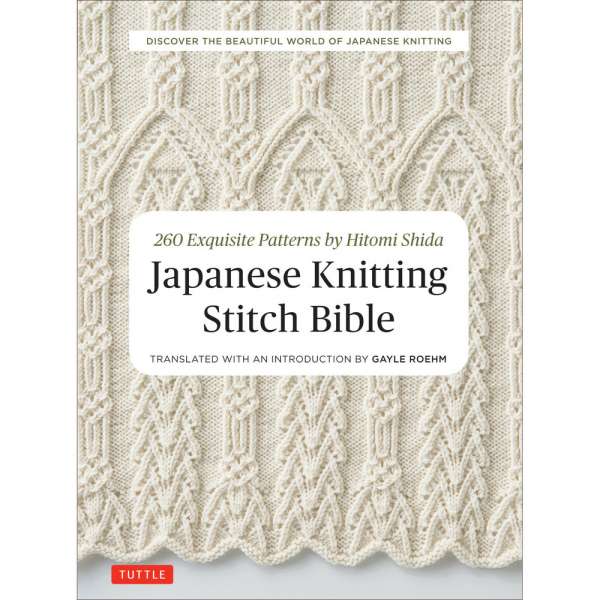
Japanese knitting patterns and knitting stitch patterns have become popular in the rest of the world over the last few years, and more books are being published for a non-Japanese audience, which is great for those of us who might be a little intimidated by the charts and a foreign language explaining what the charts mean.

Japanese Knitting Stitch Bible: 260 Exquisite Patterns by Hitomi Shida, is just one such collection, and it’s a beauty. The book includes an English introduction by Gayle Roehm, which talks a bit about Japanese knitting in general, working with charts and deciphering the symbols used in the charts. Within the patterns themselves, Japanese patterns do not usually provide a key for what the symbols mean, but there is a thorough chart of the symbols at the beginning of the book that explains what they mean and which patterns in the book use them.

The stitch patterns themselves are presented in large photos (with two or three patterns presented on most pages) with the chart presented beside it. The patterns also indicate how many stitches are used in a repeat, so you can easily add them to garments or other projects.

These stitches are gorgeous and cover a variety of styles including lacy patterns, overall patterns and crossing stitches, panel patterns, pattern arrangements (which play with different variations like adding bobbles, changing the vertical alignment of a pattern or changing the direction of the twist in a twisted stitch pattern), circular yokes and edgings. (Those last two the photos are in a gallery with the charts printed together after.)

There are also five patterns in the book: a mini scarf with frill, socks with cables, a hat with cables and eyelets, fingerless mitts and a lace collar. These patterns include more text than traditional Japanese knitting patterns, which might be a good way to practice if you haven’t worked a pattern like this before.

I tend to think Japanese knitting patterns are not the best for beginners, but if you are more visually oriented, comfortable with reading charts and confident in your ability to translate the symbols, these designs are a lot of fun.

About the book: 160 pages, paperback, 260 stitch patterns, 5 projects. Published by Tuttle Publishing, 2017. Suggested retail $16.95.
«
»

Comments

  1. Stephanie Hayes says

    June 17, 2021 at 4:44 am

    Beautiful! It makes me think of a stained glass window, the likes of which you get in old churches?

Have you read?

Book Review: The Knitting Book

There are two schools of thought when it comes to instructional books about knitting. Either focus in one particular technique or kind of knitting (stranded knitting, say, or brioche) or try to cover a little bit of everything in a reference book that knitters will use throughout their careers. 

The Knitting Book by Frederica Patmore and Dr. Vikki Haffenden aims to be the second kind. The subtitle is: a step-by-step guide to creating imaginative projects for the home and to wear. I’m not sure it does that, exactly, but it does include a quick look at a lot of different techniques and stitch patterns you might use in your projects. 

A “guide to creating imaginative projects” sounds to me like it’s about design, but this book is not. There’s 1/3 of a page about altering patterns that only talks about how to add length to a sleeve and adjust where the increases go.

There’s nothing about measuring your body (the section on choosing a size in a pattern only suggests measuring a garment you already own), general garment construction, ease or stitch pattern multiples. The section on gauge (which is the last third of the page with choosing a garment size and altering patterns, discussed above) just says to knit a swatch, block and measure it to compare to a pattern, with no discussion on how you might use your swatch to design your own project or alter a pattern to meet your gauge. 

If you ignore the subtitle, what you will find is a lot of information about different kinds of knitting and various techniques you might want to try on your projects. There are 20 cast ons and 15 bind off options, for instance, all discussed before you learn how to knit or purl. (Another quibble I have with this book is the order in which things are presented, but that’s relatively minor.)

You’ll find quick hits on increases and decreases, twists and cables, lace, colorwork, textured effects like fisherman’s rib and brioche, loops, mosaic knitting, double knitting, decorative stitches, shadow knitting, bias knitting, mitered squares, entrelac and more. There are tips for selvedge stitches, knitting with beads, adding buttonholes, picking up stitches and more. 

A few patterns at the back give knitters a taste of some of the techniques included, but they’re not rated by skill level and the first one is a bias knit gradient scarf worked in six different colors of mohair, which isn’t a thing I’d wish on any beginner. 

And I guess that’s maybe what my issue with the book is. I don’t know if it’s meant for beginners and it doesn’t seem to, either. I feel like this book would be overwhelming to new knitters and doesn’t really give you a place to start or all the information you might need to do projects well.

The variety of techniques included is fun, and there are also stitch patterns in the back you can use on your own projects, but again it doesn’t really provide any guidance for how to design your own projects so I don’t know how helpful all of that is. 

I want to like books like this because having one reference that helps you with a lot of different things is great, I’m just not sure this is the one. If you can find it at your library or local book store and flip through it before buying, I think that would be a great idea to see if it’s a book that would be helpful for you. 

And if you have this book and love it please let me know! I’m sure it’s good for someone I’m just not sure who. 

About the book: 336 pages, hardcover. Published 2026 by DK. Suggested retail price $40. 

Categories

Afghans, Blankets, Throws baby hat Baby Patterns Beginner Book Reviews cardigans Christmas Craft News and Events Free Knitting Patterns Giveaways! Hats and Beanies Knit Knitting Patterns Knitting Technique & Tutorials mittens Quick Knits scarf shawl patterns socks Sweaters

RSS More Articles

  • Book Review Wednesday: 3D Beaded Animal Crafts for Kids
  • Book Review: Simple Sashiko – 20 Easy Projects to Create & Inspire
  • Easy Lacing Cards to Make for Kids
  • 12 Nature Inspired Scrapbook Layout Designs
  • Book Review: The Knitting Book
  • DIY Little Ghoul Balls For Halloween Tiered Tray Decor
  • Free Halloween Crochet Projects You Can Finish in a Weekend
  • Cross Stitch Sheep Projects
  • Create Your Own Cozy Review: A Practical Guide to Slow Living and a More Intentional Home
  • 5 Easy Homemade Mayonnaise Recipes- Know Exactly What’s in Your Food

Pick Your Blog

  • Sewing
  • Knitting
  • Quilting
  • Crochet
  • Home & Garden
  • Recycled Crafts
  • Scrapbooking
  • Card Making
  • Polymer Clay
  • Cross-Stitch
  • Edible Crafts
  • Felting
  • Glass Art
  • Indie Crafts
  • Kids Crafts
  • Jewelry Making
  • Lesson Plans
  • Needlework
  • Bath & Body
  • Party Ideas
  • Candle Making
  • DIY Weddings
  • Not Craft
  • Free Craft Projects

Copyright © 2026 · CraftGossip | Start Here | Contact Us | Link to Us | Your Editors | Privacy and affiliate policy