Hi All,
Looking for resources to teach a pre-teen left hander how to knit and crochet.
My opinion is to teach them right handed, but then I’m righthanded myself so that only makes sense to me.
Anyone???
Free Patterns, Tutorials and Project Ideas
Hi All,
Looking for resources to teach a pre-teen left hander how to knit and crochet.
My opinion is to teach them right handed, but then I’m righthanded myself so that only makes sense to me.
Anyone???
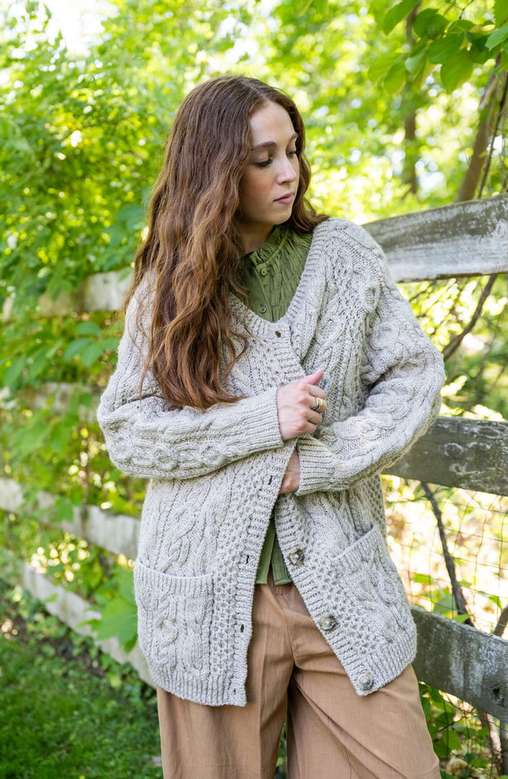 Not too long ago I did a test knit for another designer that was for a cabled cardigan. It’s really cozy and nice but it just about broke me in a ton of different ways. I couldn’t get gauge, which I suppose is my own problem, but mainly I was somehow both bored and forced to pay attention at the same time.
Because it used the same cable all over, I always had to know what row I was on, but nine out of ten of those rows, nothing in particular was going on. So I couldn’t stop paying attention, but what I needed to attend to was boring.
It may have ruined me for knitting cabled sweaters, but maybe I just need something that’s more engaging. Like this Modern Aran Cardigan pattern from Lion Brand Yarn.
This is a reworking of an old pattern from their archives, and you can tell that form the classic look of the cables and the oversized feel (nothing cropped about this one!). It has allover cables, but like a classic Aran sweater it’s not the same cable, so you’ll have to pay attention to what row you’re on and what cable turns happen for which cables on that row.
Because of this, it’s considered an intermediate knitting pattern, but if you’re comfortable working from multiple charts at once it shouldn’t be a problem for you. There are three different charts and seven different cable moves.
Also because the pattern is so big and boxy there are only two sizes available, with a finished chest measurement of either 49 or 63 inches (that’s 124.5 or 160 cm). It’s up to you to decide how much ease you would like and whether that will work for your body.
The pattern uses worsted weight yarn (and calls for another classic, Lion Brand Fisherman’s Wool). It calls for six buttons and includes pockets to make it extra cozy.
This one looks like a great winter project to make and to wear if you’re up for a bit of a challenge. You can grab the free pattern or buy a kit with the yarn needed direct from Lion Brand Yarn.
[Photo: Lion Brand Yarn]
I’m not sure if it is the same for knitting but as for crochet try youtube. tjw1963 has great left handed videos for learning to crochet. I myself also have left handed videos on new crochet stitches. I am not left handed but only offer the left handed versions through the help of video mirroring. My suggestion would be to look on YouTube and if you don’t see anything you like there then you can always ask a good knitting friend that may have a right handed video to make a left handed version. All it takes is one click on my windows movie maker live to do this. If you can’t find anyone to help shoot me an email and I can explain it in better detail.
I am left handed – and learned to knit righty. My motion is not as smooth as right-handed people, but I am so glad I learn righty because it makes it so much easier to learn new stitches without needing special instructions.
Lefties are used to having to adapt and adjust, I’d try right handed knitting first!
I am left handed and there are a number of sites that will help how to teach knitting to someone who is left handed. People who are left handed are more apt to pick when knitting or to do the Continental method of knitting rather than throwing or the English method.
I taught myself by mirroring the continental (picking) method of knitting. Same with crocheting–but I’m sure there are online resources for it.
Hi! I’m a lefty who taught myself to knit left handed with a book, but got frustrated trying to follow knit patterns properly and learn new stitches, so I re-taught myself to knit right-handed. I would definitely try to teach them to knit right-handed, but holding the yarn continental.
I taught myself knitting, first right handed English then Continental (my preferred method). Then I learned to “Knit Back Backwards”, which really means knit left handed, throwing. I haven’t done much purling left handed yet. I’ve also yet to try, but do want to master, left handed picking.
Sorry for the long preamble, but my advice is to learn them all yourself, so you can teach anyone.
oh I forgot to mention my youtube channel is texasyarnlover. Thanks. And don’t forget to shoot me an email or pm me on YouTube if you need more help.
If the stitches move in the opposite direction, from the right-hand needle to the left-hand needle, the shaping for things like cardigan fronts and buttonholes will have to be reversed from what’s in the pattern. I taught my left-handed daughter to knit continental, and she did fine.
I am left handed. A friend of mine who is right handed teach me crochet and it was very hard to me to understand in which way shoul I yard or how to do the basis stiches.
Only when I found some video tutorials for left handed I understood the stiches.
I would like to highly recommend a youtube user “tjw1963” for learning both right AND lefthanded crochet. Her website info is always listed in the description boxes and she always has a video and written pattern so you can follow along and get a visual as well.
I am teaching some kids to crochet and some are lefties, I have decided that it is simpler for them to go with ther left hand, it was a bit difficult for me to teach them …but I have found that it is simpler to do with them some stitches (just to show them the movments) together when they are facing me.
Actualy it was funny that suddenly the teacher is crocheting slower…. It was good for their confidence that I am having some trubles to….
Hope this help
I’m left handed and learned how to crochet right handed – no problems here!
I am an ambidextrous lefty in all things, using both hands almost equally, but favoring the left for writing. I just realized that I knit right handed but crochet left handed. I knit English style and throw the yarn and the comment above about picking up new stitches and following tutorials is correct, it is easier when you knit right handed. I am trying to follow a tute for crocheted slippers, which is when I realized I crochet lefty and it isn’t easy to follow her backwards. If your student can learn righty, go for it!
I’m a lefty and thought i would have to learn backwards,much like my crochet….but in watching a video i learned the standard way, which to me is not left or right handed since both sides of the brain & both hands are involved… just keep practicing and the muscle memory will come!!
I’m a leftie, I learnt to knit as a child then again as an adult and to crochet as an adult. I learnt both right handed and it is really easy – it makes more sense to me. It would be really difficult for your student to learn new stitches and techniques from books/classes/the internet if you teach her left handed. Go right handed is what I say!
As handcraft teacher I recommend teaching the right hand way; as it was said before, both hands/ sides of the brain are involved with knitting anyway, instructions are easier to follow and the left hand will be fantastic with keeping the tension if you teach the continental way of knitting!
Like learning an instrument or bike riding, the muscles will soon know what to do.
By the way, everything you do with the hands has far more influence on everything else they learn as we usually assume, music and handcraft are especially good for mathematics!
The person learning the craft should have the choice of which hand to learn with. I am a lefty and crochet left-handed because I was taught by my left-handed mother. There are a few things I do right-handed because there were no left-handed resources. But with crafts, I am most comfortable doing things left-handed. Forcing someone to learn with their “off” hand could cause them to lose interest. Some lefties find doing things right-handed extremely difficult.
A righty can teach a lefty to knit/crochet by sitting IN FRONT of the student and have the student follow your actions. Don’t use words like “use your left hand here or do this with your right hand” because it is opposite for the student. Make the lessons completely visual with motions. For example: wiggle the fingers of the hand you are talking about and say “use this hand for…” Lefties are very talented crafters and generally adapt easily.
Even though I am a lefty, I have had very little trouble following instructions in crochet patterns. I just have to remember to do the opposite where it matters which is seldom.
My sister got taught by my mom (who is right handed) using the book:
Learn to Crochet in Just One Day (left -handed version) by Jean Leinhauser
My sister was about 8 or 9 when she was taught.
Hope this helps!
–Roxy
Utilize YouTube.com it’s great! Most of the time the basic stitches for crochet and knit are available for left/right handed people.
When I was learning how to use a mouse (20+ years ago) the instructor offered to set me up using my left hand but I knew it would be confusing to always have to reverse instructions – – similar to my unsuccessful knitting adventures.
At age 10, my (right handed) twin sister tried to teach me (the lefty twin) but now, 40+ years later, I realize it’s time to enjoy the craft and unlearn bad habits and start over from a right handed perspective.