 It’s common throughout the world that there are fewer statues of women than there are of men, and typically more of the men are real people, while the female statues are often goddesses or characters from mythology.
They’re also often naked.
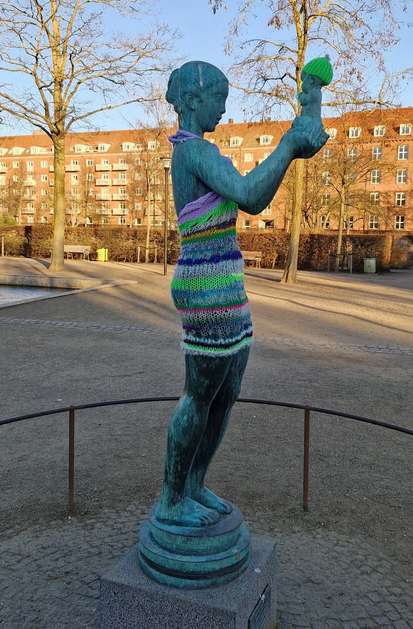
Knitter Louise Moerup knit a dress for a statue of Venus in a park in Copenhagen after talking with her 10-year-old son about the fact that she was naked and wondering at the lack of real human women depicted in statues.
In Denmark there are 484 monuments to historically significant men, compared to just 43 of women. But there are 120 female nude sculptures, often of mythological or allegorical figures.
“It wasn’t really the nudity that made me want to knit her dress,” Moerup told the New York Times, “but the absence of women who are remembered for their achievements. Knitting the dress was my humorous way to make people look twice and notice what’s missing.”
After her project gained notice, knitters and crocheters across the country began to make clothing for naked statues.
Culture minister Jakob Engel-Schmidt said it’s coincidental that the government recently earmarked $1.5 million to fund public are that represents historically significant women.
But even if the knitters didn’t cause the government to act, they certainly got people talking about the representation of women in public art. Not always in a positive way, as some likened the covering of statues to vandalism, or complained about covering “beautiful women’s bodies” (you can probably guess that comment was from a man).
And knitters haven’t stopped covering the statues even with the announcement of funding. But the dress that started it all is now in a museum in Copenhagen because curators were worried dye from the yarn could harm the bronze in the rainy season.
It’s just another way that knitters and crafters are using their art to draw attention to important issues, which I love.
[Photo by Louise Moerup via the New York Times]