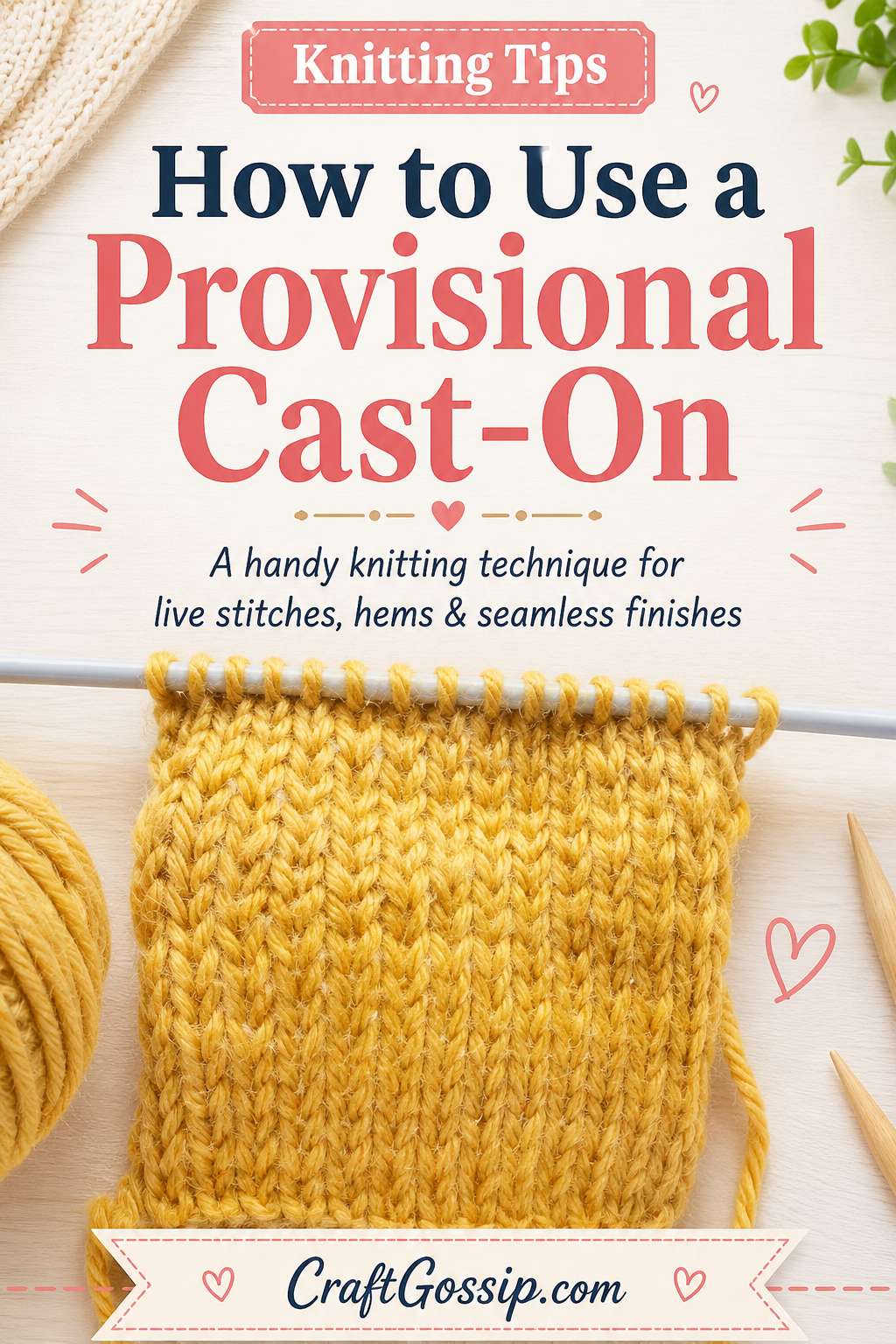
A Provisional Cast-On is a very necessary technique to know, and to have in your techniques arsenal. If there’s any reason to want to go back and knit from the beginning in the opposite direction, this is the skill to have.
A provisional cast-on is one of those knitting techniques that sounds a little fancy until you actually use it — and then you wonder why you avoided it for so long.
In the simplest terms, a provisional cast-on is a temporary cast-on. Instead of creating a permanent starting edge, you cast on in a way that allows you to come back later, remove the waste yarn, and place those first stitches back onto your needle. From there, you can knit in the opposite direction, graft two pieces together, add a border, or create a beautifully seamless finish.
It is a very handy technique to have tucked away in your knitting toolbox, especially if you enjoy scarves, shawls, cowls, sweater hems, folded edges, or anything where you want a neat, professional-looking finish without a bulky seam.
And yes, the first time you unzip a provisional cast-on, it can feel slightly terrifying. We’ve all had that moment of looking at live stitches and thinking, “Well, this could go very wrong very quickly.” But with a little patience and a smooth contrast yarn, it really is one of those skills that becomes much less scary once you try it.
What Is a Provisional Cast-On?
A provisional cast-on is a temporary way to begin a knitting project so that the first row of stitches remains live and usable later.
Instead of being locked into a permanent edge, those stitches are waiting for you. When the time comes, you remove the waste yarn or crochet chain holding them in place, pick up the live stitches, and continue knitting.
This is especially useful when a pattern asks you to:
- knit in both directions from the same starting point
- graft two ends together invisibly
- add a folded hem
- create a seamless cowl or scarf
- add borders after the main knitting is complete
- keep your finishing options open
Think of it as leaving a little door open at the beginning of your knitting. You can come back through it later.
When Would You Use a Provisional Cast-On?
A provisional cast-on is useful anytime you might want to work from the beginning edge later.
One common example is a scarf or stole that needs to look the same at both ends. Instead of casting on at one end and binding off at the other, you can start in the middle with a provisional cast-on, knit one half, then return to the live stitches and knit the other half in the opposite direction. This keeps the stitch pattern balanced and avoids that awkward “one end looks different” problem.
It is also useful for cowls that are joined with grafting. If you have ever wanted a seamless knitted tube with no obvious beginning or end, a provisional cast-on is usually part of the magic.
You might also see it used in sweater patterns for hems, collars, cuffs, or decorative edges. A folded hem, for example, can be joined neatly to live stitches for a clean finish.
If you are still building your cast-on confidence, you may also like reading our post on choosing your favorite cast-on method, which is a useful reminder that no single cast-on is perfect for every project.
Why Knitters Love a Provisional Cast-On
The biggest benefit of a provisional cast-on is flexibility.
With a regular cast-on, your starting edge is finished as soon as you make it. With a provisional cast-on, you are saving those stitches for later. That gives you more control over the final look of your project.
A provisional cast-on can help you create:
- smoother joins
- matching ends on scarves and shawls
- tidy folded hems
- invisible grafted seams
- removable or adjustable edging
- cleaner finishing on advanced projects
It is one of those little techniques that makes your finished knitting look more polished, even if the rest of the project is quite simple.
What You Need for a Provisional Cast-On
You do not need much to try this technique.
You will need your project yarn, a smooth waste yarn in a contrasting colour, and your knitting needles. Some versions also use a crochet hook, especially if you are working the crochet chain provisional cast-on.
The waste yarn matters more than you might think. Choose something smooth and non-fuzzy so it can be removed easily later. This is not the time for fluffy mohair, boucle, or that mystery novelty yarn lurking in the back of the stash. We all have one. It can stay there.
Cotton yarn or a smooth acrylic yarn usually works well as waste yarn. If you knit often, it is worth keeping a small ball of bright contrast yarn in your project bag just for provisional cast-ons, lifelines, and stitch-holding moments.
If you are stocking up on knitting basics, a few useful supplies to keep nearby include stitch markers, tapestry needles, spare circular needles, a crochet hook, and a smooth contrast yarn. Mary Maxim and Amazon are both good places to look for simple knitting tools and yarn basics, especially if you like having a little technique kit ready before you start.
The Crochet Chain Provisional Cast-On
One of the most common ways to make a provisional cast-on is with a crochet chain.
With waste yarn and a crochet hook, you make a chain that is longer than the number of stitches you need. Then you pick up stitches through the bumps on the back of the chain using your working yarn. Later, when you are ready to use those live stitches, you carefully undo the crochet chain and place the stitches onto your knitting needle.
This method is popular because it is fairly easy to remove when done correctly, and it works well for many patterns.
A quick tip: make your crochet chain a few stitches longer than you think you need. It gives you a little breathing room at each end, and no one ever regretted having a few extra waste-yarn chains. Running out too soon, however, is the sort of thing that makes a cup of tea suddenly feel necessary.
How to Pick Up the Live Stitches
When your pattern tells you to return to the provisional cast-on, take your time.
Undo the waste yarn slowly and place each live stitch onto your needle as it appears. Do not pull the whole chain out at once unless you are very confident. It is much safer to release a few stitches at a time.
Some stitches may be mounted the wrong way on the needle. That is normal. Simply turn them so they sit correctly before knitting them. This is not a mistake; it is just part of the process.
If a stitch tries to escape, use a crochet hook or spare needle to catch it. This is also a good reason to work in good light and avoid doing this step while half-watching television. Ask me how I know.
For knitters still working on cast-on basics, our tutorial on how to knit the knit cast-on is a good beginner-friendly place to start. Once you understand how stitches are formed on the needle, provisional cast-ons make much more sense.
Common Provisional Cast-On Mistakes
The most common mistake is using waste yarn that is too similar in colour to your project yarn. You want contrast. Good contrast. The kind you can see without squinting.
Another common problem is using sticky or fuzzy yarn as waste yarn. If the fibres cling together, removing the provisional cast-on can become unnecessarily fiddly.
It is also easy to pick up the wrong part of the crochet chain. When using the crochet chain method, make sure you are picking up through the back bumps of the chain unless your tutorial or pattern says otherwise. This helps the chain unzip more neatly later.
And finally, do not rush the removal step. Live stitches are wonderful, but they are also very good at making a run for it if you tug too enthusiastically.
Provisional Cast-On vs Regular Cast-On
A regular cast-on creates a permanent beginning edge. A provisional cast-on creates a temporary edge that can be removed later.
Use a regular cast-on when the edge will stay as it is. Use a provisional cast-on when you need access to those stitches later.
A provisional cast-on is not necessarily better than a long-tail cast-on, knit cast-on, or cable cast-on. It simply does a different job.
For a firmer edge, you might use a cable cast-on. For a beginner-friendly method, a knit cast-on can be lovely. For a flexible temporary edge, provisional is the one you want.
This is why learning several cast-on methods is so useful. The more techniques you know, the better you can match the cast-on to the project instead of forcing every pattern to behave with the same method.
Troubleshooting Tips
If your provisional cast-on will not unzip neatly, stop and look closely at the chain. You may be trying to undo it from the wrong end. Crochet chains usually unzip from one direction much more easily than the other.
If the live stitches look twisted, place them on the needle first and then correct the stitch mount before knitting.
If you are nervous about losing stitches, use a smaller needle or circular needle to pick them up. A circular needle gives the stitches somewhere safe to sit while you work across them.
If you drop one of the cast-on stitches, do not panic. It can usually be rescued with a crochet hook. You may also find our post on how to fix a dropped cast-on stitch helpful if your stitches get a little lively.
Is a Provisional Cast-On Beginner Friendly?
I would call it an adventurous beginner technique.
You do not need to be an expert knitter to learn it, but it does help if you are comfortable knitting, recognizing stitches, and picking up stitches. If you are brand new to knitting, practice first on a small swatch rather than using it for the first time on a lace shawl or sweater hem.
Cast on 15 or 20 stitches with waste yarn, knit a few rows, then practise removing the provisional cast-on and placing the live stitches back onto your needle. That little practice swatch will teach you more than reading about the technique ten times.
And because it is just a swatch, there is no pressure. No precious yarn. No deadline gift knitting. No panic.
Why This Technique Is Worth Learning
A provisional cast-on opens up so many possibilities in knitting. It allows you to create seamless pieces, match both ends of a project, add borders later, and finish hems beautifully.
It is also one of those techniques that quietly builds your confidence. Once you understand that a cast-on does not always have to be permanent, knitting starts to feel a bit more flexible and creative.
So if you have been avoiding patterns that mention a provisional cast-on, this is your gentle nudge to give it a try. Start with a swatch, use a nice bright waste yarn, and take it one stitch at a time.
It might feel fiddly the first time, but once you see those live stitches sitting neatly on your needle, you will understand why so many knitters keep this technique close at hand.
For even more cast-on inspiration, visit our cast-on cheat sheet and start building your own little mental library of knitting starts. It is one of the easiest ways to make your projects look cleaner, fit better, and feel a little more professionally finished.
Originally, this article shared a Creative Knitting tutorial on working with a provisional cast-on. This expanded update adds more explanation, troubleshooting tips, and practical advice for knitters who want to understand when and why to use this very useful temporary cast-on technique.
This tutorial from Creative Knitting will have you mastering this imperative skill quickly and easily! Click HERE to find out how!
Sign up for their newsletter and get more hints and tips like this, as well as free patterns!