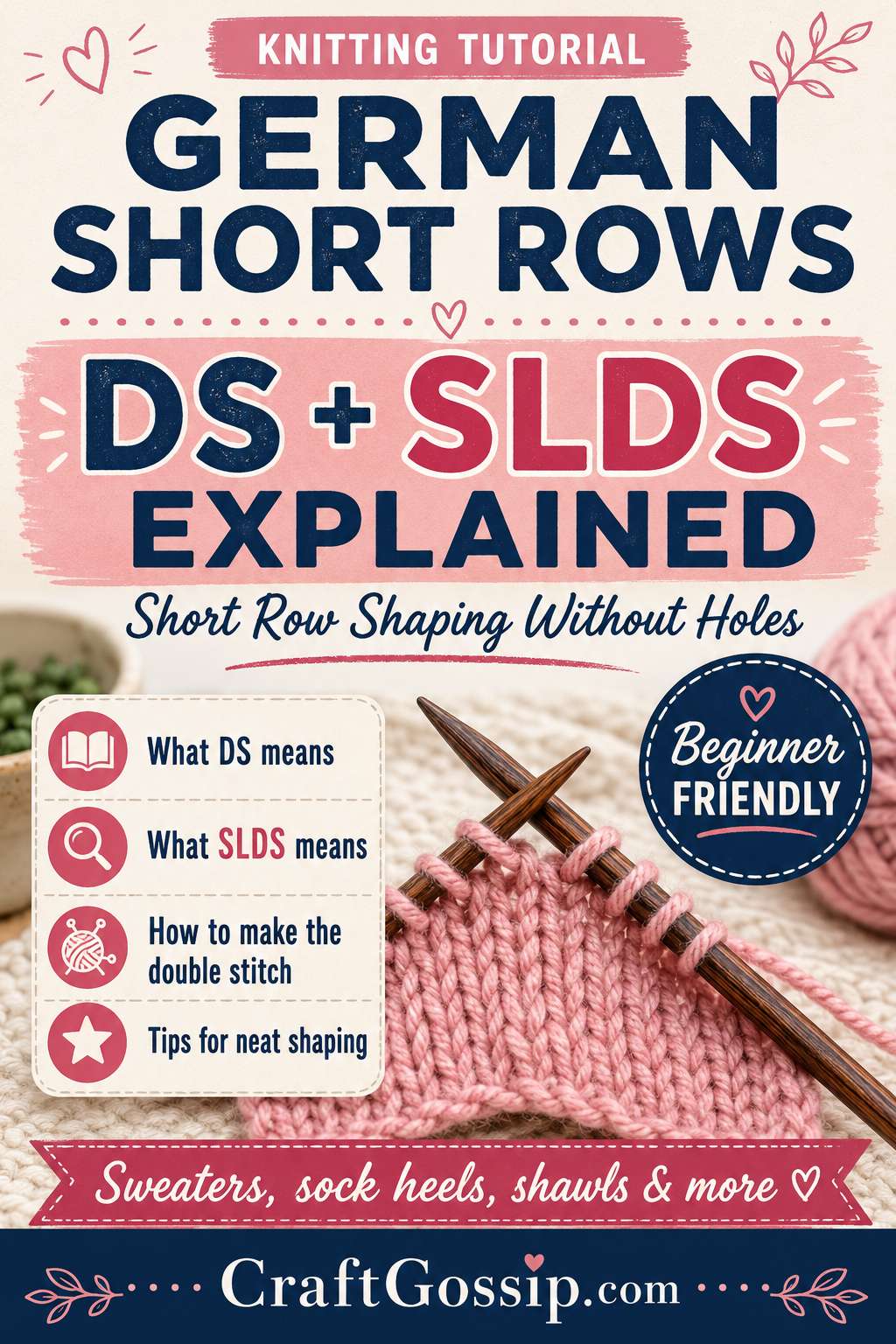
If you have ever been happily knitting along and then hit the words German short rows, DS, or worse, something like SLDS, and suddenly felt like your pattern had switched languages mid-row, you are absolutely not alone.
German short rows are one of those knitting techniques that sound far more intimidating than they really are. Once you understand what the “double stitch” is doing, the whole thing becomes much less mysterious. It is basically a neat little turning trick that lets you add shape to your knitting without leaving big gaps, holes, or those slightly suspicious wrap-and-turn lumps that can make us squint at our work under a lamp and mutter unkind things.
German short rows are commonly used in sweater necklines, shoulder shaping, sock heels, bust shaping, shawls, yokes, and anywhere a knitting pattern needs extra fabric in one area without adding it everywhere. They are especially useful for top-down sweaters, where a little short row shaping at the back neck can make the finished garment sit so much better.
If you are new to sweater knitting, you might have already seen this technique pop up in modern raglan sweaters and yoke sweaters. We have shared sweater patterns on CraftGossip before where the neckline is shaped with German short rows, including this simple-looking sweater full of fun knitting techniques and the lovely Ebb and Flow sweater knitting pattern. Once you know what the pattern is asking for, those instructions feel a lot less scary.
What Are German Short Rows In Knitting?
German short rows are a method of creating short row shaping by turning your work before the end of a row and making a double stitch, usually abbreviated as DS.
A short row is simply a row that is not worked all the way across. Instead of knitting to the end, you stop partway, turn your work, and go back in the other direction. This creates extra rows of fabric in one section of your knitting.
That extra fabric can help shape:
- the back neck of a sweater
- the heel of a sock
- the curve of a shawl
- bust shaping
- shoulder slopes
- raised backs on cardigans
- rounded toy or doll pieces
The clever part of German short rows is the double stitch. This double stitch closes the gap where you turned, so your knitting looks smoother and neater when you come back to work across it later.
If you want a gentle project to practise the idea of short rows before using them in a garment, this colorful knit blanket for practising short rows is a nice low-pressure option. Blankets are very forgiving. Sweaters, as we all know, have opinions.
What Does DS Mean In Knitting?
In German short row knitting, DS means double stitch.
This does not mean you are increasing. It looks like two loops on the needle, but it counts as one stitch.
That is the bit that catches beginners out. You see two strands sitting on the needle and your brain says, “Aha, two stitches!” But no. That little double-legged creature is one stitch wearing a fancy hat.
When you come back to the double stitch later, you work both legs together as one stitch. This keeps your stitch count the same and helps close the hole from the turn.
What Does SLDS Mean In Knitting?
This is where things get a little messy, because SLDS is not always written consistently across knitting patterns.
In many short row instructions, SLDS or sl-ds usually means something like:
Slip double stitch
or
Slip the double stitch
You may also see it written as:
- sl ds
- sl-ds
- slds
- sl1 DS
- slip DS
- sl-ds wyif
- sl-ds wyib
If your pattern says sl-ds wyif, it likely means slip the double stitch with yarn in front.
If it says sl-ds wyib, it likely means slip the double stitch with yarn in back.
This often appears in more advanced short row patterns, especially where German short rows are combined with slipped stitches, colorwork, textured sections, or decorative shaping.
The important thing is to read the pattern’s abbreviation section first. If the designer has not explained SLDS clearly, treat it as a signal to look closely at the row context. Most of the time, it is referring to slipping a double stitch rather than creating a new one.
Why Use German Short Rows Instead Of Wrap And Turn?
A lot of knitters prefer German short rows because they are simple, tidy, and easy to remember.
With wrap and turn short rows, you wrap the stitch before turning, then later pick up the wrap and work it with the stitch. That works beautifully once you know what you are doing, but it can feel fiddly when you are learning.
German short rows skip the wrapping part. You turn, slip the stitch, pull the yarn firmly to make a double stitch, and carry on.
I find German short rows especially helpful when I want shaping that doesn’t shout, “Hello, I was turned here!” from across the room.
Short rows are also used in sock heels, and if socks are your next knitting mountain to climb, you may like this older CraftGossip post on how to knit a short row heel. We have also reviewed sock resources such as Knit a Box of Socks, which includes German short rows among the helpful sock-knitting skills covered.
If you are buying yarn for a short row project, a smooth wool or wool-blend yarn is easier to learn on than a fuzzy novelty yarn. A good basic yarn from Mary Maxim or a set of locking stitch markers from Amazon can make learning short rows much less frustrating, especially if you are marking turning points as you go.
How To Knit German Short Rows On The Knit Side
Here is the basic method for working a German short row when the knit side is facing you.
Step 1: Knit To The Turning Point
Knit across the row until your pattern tells you to turn.
For example, your pattern might say:
Knit 20, turn.
Stop after knitting those 20 stitches.
Step 2: Turn Your Work
Turn your work so the purl side is now facing you.
Keep the working yarn at the front of the work.
Step 3: Slip The First Stitch
Slip the first stitch from the left needle to the right needle purlwise.
Do not knit or purl it. Just slip it.
Step 4: Pull The Yarn Firmly
Pull the working yarn up and over the needle toward the back of the work.
This tug lifts the slipped stitch up and makes it look like two legs sitting on the needle. That is your double stitch, or DS.
You do need to pull firmly, but not so firmly that you distort the surrounding stitches. There is a sweet spot here, and yes, it may take a little swatching to find it. Annoying, but worth it.
Step 5: Continue Purling
Now continue working the row as instructed.
When you come back to that double stitch later, work both legs together as one stitch.
How To Knit German Short Rows On The Purl Side
German short rows can also be made when the purl side is facing you.
Step 1: Purl To The Turning Point
Purl to the place where your pattern tells you to turn.
Step 2: Turn Your Work
Turn your work so the knit side is now facing you.
Keep the working yarn at the front.
Step 3: Slip The First Stitch
Slip the first stitch purlwise from the left needle to the right needle.
Step 4: Pull The Yarn Firmly
Pull the yarn up and over the needle toward the back, creating the double stitch.
Step 5: Continue Knitting
Continue knitting as your pattern instructs.
When you reach the double stitch later, knit both legs together as one stitch.
How To Work The Double Stitch Later
When you come back to a German short row double stitch, you need to work both legs together.
If you are on a knit row, knit both legs of the double stitch together as one stitch.
If you are on a purl row, purl both legs of the double stitch together as one stitch.
This is the step that makes the shaping disappear neatly into the fabric. Do not work each leg separately or you will accidentally increase your stitch count and possibly create a little lump where you wanted smooth shaping.
German Short Rows In The Round
German short rows can be worked in the round, but they can be a little trickier because you eventually need to pass the turning point and continue around.
You will often see German short rows in the round used for:
- sweater yokes
- raised back neck shaping
- sock heels
- circular shawls
- pants or leggings
- baby rompers
- shaped cowls
When working in the round, place markers exactly where your pattern tells you to. Short row shaping in the round often relies on turning before and after certain markers to build fabric in a specific area.
For sweater knitting, German short rows are often used near the back neck so the front neckline sits lower and the back sits higher. That small shaping detail can make a handmade sweater feel much more comfortable to wear. If you enjoy textured sweater patterns, this yoked sweater with tons of texture is another example of a project where German short rows are part of the skill set.
How To Substitute German Short Rows For Wrap And Turn
This is one of the most useful reasons to learn German short rows.
If a pattern uses wrap and turn instructions, you can often substitute German short rows, but you need to understand what corresponds to what.
In wrap and turn shaping, the wrapped stitch marks the turning point.
In German short rows, the double stitch marks the turning point.
So, if a pattern says:
Knit to 3 stitches before wrapped stitch, wrap and turn
For German short rows, you usually work to the equivalent place, work one extra stitch to replace the wrap action, then turn and make the double stitch.
This is the kind of conversion that becomes much clearer when you swatch it. I know swatching is not everyone’s idea of a thrilling Saturday night, but it is much better than ripping back half a yoke while trying not to say words your grandmother would not approve of.
If you like learning short row shaping through accessories rather than garments, this CraftGossip post on an easy shawl pattern for mastering short rows is a useful next read.
Common German Short Row Problems And How To Fix Them
My German Short Rows Have Holes
This usually means the double stitch was not pulled firmly enough, or the first stitch after the double stitch was worked too loosely.
Try pulling the yarn a little more firmly when creating the double stitch. Also make sure you are working both legs of the DS together when you return to it.
My Double Stitch Looks Too Tight
You may be pulling too hard. The double stitch should be firm and obvious, but it should not strangle the stitch beside it.
If your fabric is puckering, relax your tension slightly.
I Lost Track Of My Double Stitches
Use stitch markers. Truly. This is not cheating.
Place a locking stitch marker near your turning point if the pattern is complicated. You can also use a removable marker to tag the double stitch itself while you are learning.
I Accidentally Worked The Double Stitch As Two Stitches
This creates an unwanted increase.
If you notice it soon enough, tink back and work both legs together as one stitch. If you are several rows past it and the stitch count still matters, you may need to decrease discreetly later, but for fitted garments it is usually worth fixing properly.
My Short Rows Look Lumpy
Some lumpiness is normal when learning. German short rows improve with practice, and they also look better after blocking.
A small practice swatch in smooth, light-colored yarn will teach you more than trying to learn the technique for the first time in dark navy fluffy yarn. Ask me how I know.
Best Projects For Practising German Short Rows
If you want to practise German short rows without committing to a full sweater, try them on a small swatch first.
Good beginner projects include:
- a simple garter stitch swatch
- a plain stockinette swatch
- a small doll sweater
- a baby cardigan
- a basic sock heel
- a small shawl section
- a cowl with shaping
Once you are confident, try them in a sweater neckline or sock heel. Socks are a great place to use this skill because short rows create shaping in a small, manageable area. This CraftGossip post on unconventionally striped socks mentions a German short row heel, which is a nice example of the technique being used in a more modern sock design.
If you prefer learning from printed instructions, check whether your favourite knitting books include technique sections on short rows. Etsy can also be useful for finding independent knitting patterns that specifically mention German short rows, but always read the pattern notes before buying so you know the technique is included or explained.
German Short Row Abbreviations You Might See
Here are some common abbreviations linked to German short rows:
DS — double stitch
MDS — make double stitch
GSR — German short row
sl-ds — slip double stitch
SLDS — slip double stitch, depending on the pattern
wyif — with yarn in front
wyib — with yarn in back
turn — turn your work before reaching the end of the row
SR — short row
Always check the pattern’s abbreviation section because designers do not all write short row instructions the same way.
Beginner Tips For Neater German Short Rows
Use a smooth yarn while learning. Splitty yarn makes the double stitch harder to see.
Practise in a light color. Dark yarn hides everything, including your mistakes and your will to continue.
Count the double stitch as one stitch. Even though it has two legs, it is still one stitch.
Work both legs together when you reach the DS later.
Use stitch markers for turning points.
Block your swatch before judging the finished look. Some short row shaping looks a little odd on the needles and much better after blocking.
Why German Short Rows Are Worth Learning
German short rows are one of those knitting techniques that seem fussy at first, then suddenly become part of your regular knitting toolkit.
They make sweater necklines sit better. They help sock heels fit more comfortably. They create smooth shaping in shawls and accessories. They are also easier to remember than many wrap-and-turn instructions once you have practised them a few times.
And if you have ever abandoned a pattern because it said DS, MDS, or SLDS, now you know what those little abbreviations are trying to tell you.
German short rows are not nearly as scary as they look. They are just a clever way of turning your work, pulling one stitch into a double stitch, and later working that double stitch as one. Once your hands understand the motion, you may find yourself choosing German short rows even when a pattern gives you another option.
Thank you so much for explaning WHY the double stitch is required. It made no sense to me until now. It sounds like it is a type of increase, but since you knit/pearl through them both, I knew it wasn’t an increase. You also have a great style of writing. Thank you!